|
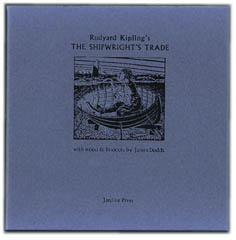
"Jamie,
as yet, I trust, does not identify with Noah but the nostalgia
engendered by KiplingÕs poem has given him the opportunity to
present this selection of linocuts which all relate to a period
in his past.
Kipling
drew his inspiration from the workaday aspect of ships and the
sea, but remained a detached observer. The pictorial artist,
who has earned a living from an occupation that now provides
subject matter, has the advantage of technical understanding
and is perhaps able to avoid a romantic image.
Jamie
served his time in the shipwright's trade at a yard where Noah
would have felt entirely at home. The business was established
in Maldon for wooden barge building in 1894 (the year Kipling
wrote his notable maritime poem 'The Mary Gloster') and continues
to the present day with the re-building and re-rigging of sailing
barges.
Apprentices
learnt how to use the adze and other hand tools as old as the
Ark. They had to suffer being watched by old men, some knowledgeable
who are the most infuriating, but mostly by those who would
just comment, 'you don't see this sort of work anymore'.
Jamie,
even after all these years, is probably happier with the label
'ex-shipwright' than 'artist', but he knows, and this is what
may produce the nostalgia, that there is no going back."
D. J. Patient B.A. Shipwright Maldon, Essex 1990
1st
ed: Jardine Press 1990. ISBN: 0 9509270 4 X
2nd ed: Mystic Seaport 2001. ISBN 0 939510 72 3
3rd ed: Jardine Press Ltd 2002. ISBN: 0 9509270 4 X
200 x 200mm, 32pp.
Hardback: £9.95.
|