Late
Autumn Sunlight
East
Anglian Verses
by Martin Newell
Linocuts
by James Dodds.
Second
edition 2007
Introduction
by Ronald Blythe.
An
introduction, in fact, to a pair of collaborationists who need
no introduction. There cannot be many parts of Britain where
a local scene is so well caught by poet and artist together.
Were it not for Martin Newell and James Dodds today's East Anglia,
and especially coastal North-East Essex, would, like so many
places, be identified in the usual generalised terms of a commuting
area, plus some inviting tourist language. But they will have
none of this and between them they have for a long time now
revealed the true nature of their homeland. Martin Newell casts
a protective eye over it. There is nothing he cannot see and
nothing he cannot value. Although his vision is proprietorial,
he wants to share it. He has a genius for relating the past
to the present and not making all kinds of things sound out-dated.
His poetry is an inventory of the region. He does not deal in
"by-gones" but in what connects. He is affectionately
caustic, witty and moving, a great local voice which, via a
stream of work in The Independent, is listened to far and wide.
He has always possessed a sad ear for decline, for the running-down
but not the vanishing of things, and Late Autumn Sunlight is
a subject which suits him. It is wry, funny, profound, a signpost
to what could so easily be missed, wonderful sights, unique
detail, views which change the reader's perspective. Which is
what poetry is for.
Martin
Newell could not have found a better sharer of his vision than
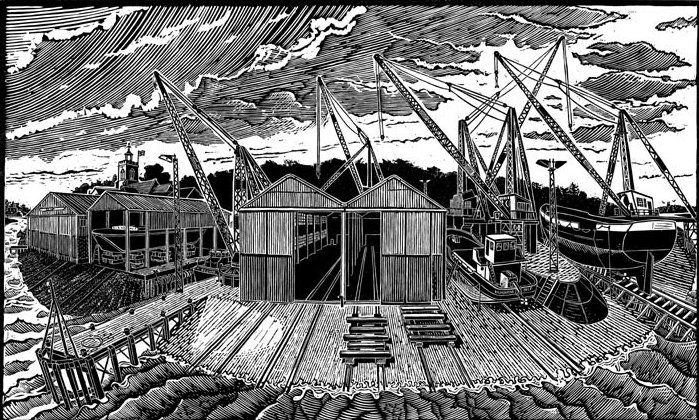
James Dodds. His strong lino-cuts provide a perfect accompaniment
to the words but rightly do not attempt to illustrate them.
Where the poet lists the real natives, the real activities of
his corner of the world, the artist takes its harbours back
to their essentials of shipping, storytelling, worship and domesticity.
The populations of Aldeburgh and Wivenhoe are captured - walled-up,
almost - between soil and sea. James Dodds also captures that
freedom of the coast which makes sailors and fishermen another
race. Both he and Martin Newell have a wary delight in local
legends and Late Autumn Sunlight contains an extract from Black
Shuck, to my mind a masterly re-telling of Eastern England's
ghostly dog tale. shuck makes the Hound of the Baskervilles
sound like man's best friend. The Newell version, with Dodds'
pictures, is classic folklore and not to be missed.
Martin
Newell's East Anglia tumbles about untidily, and points a finger
at contemporary suburban standards. "Where is your soul?"
he consistently asks. It is a question we have to answer. Is
it in theme parks, in the tarted-up pub, at the rat-race? James
Dodds' east Anglia is crafted in shipyards, farmyards and workshops,
including the studios of its many artists. These were for him
during his youth the places where skill came from hands, not
words. A shipwright tells his apprentice, "I shan't say
noth'n. You watch me" Newell and Dodds show how close they
are in this first poem of their latest book. Their work is a
combination of doing - and dreaming. Its pace is set to some
extent by the poet's bike and by the slowed-up discipline of
the linocut. Nothing flashes past them or is dashed off. There
is contemplation. East Anglians are returned to their roots,
non-natives given a delightful crash course on what these coastal
counties really are, on what made them.
Frequently
local writers and artists go over the old ground, the famous
names and villages, the much repeated customs and the tourist
routes. But not here. Martin Newell "sings" what both
East Anglia and its visitors would never see. Modest lanes,
ordinary people, not "characters", the minutiae of
life, marvellously personal sightings of birds and plants are
brought to our attention. He is a poet who says, "Look
at what you are missing!" James Dodds' work is an act of
love which incorporates a sturdy reality and legend. His small
coastal towns are anchorages for other things as well as ships.
Martin Newell has more to say about the latest inhabitants than
the oldest inhabitants, and caustically. He sees East Anglia
under constant invasion by one horde or another but able to
hold its own. Humanity and its detritus ultimately touches his
heart. So here is a two-man guide to the edges of Norfolk, Suffolk
and particularly to border-line Essex; some poems and pictures
which will make us look at them differently.
-
Ronald Blythe, 2001
2nd
edition Jardine Press Ltd 2007
148 x 210mm, 84pp.
ISBN
978 0 9552035 4 1
Paperback: £7.95
|